How the Music Industry Works
The Independent Artist's Blueprint for Ownership, Distribution and Revenue Royalties

On a rainy Tuesday night, an independent artist hits "submit" on a digital distribution dashboard, sending their newly mastered track into the digital ether. Within hours, that file is live on Spotify, Apple Music, and TikTok, accessible to billions of people. To the uninitiated, it looks like magic: a direct, frictionless pipeline from creator to consumer.
But behind that seamless click lies a sprawling, invisible labyrinth of legal contracts, corporate gatekeepers, and complex financial engines. The truth is, the modern music industry is not just a creative community; it is a multi-billion-dollar global machine powered by two distinct forms of intellectual property, managed by competing entities, and monetized through a web of micro-transactions. For any creator, executive, or observer looking to navigate this landscape, understanding how these moving parts click together is the difference between building a sustainable career and getting lost in the noise.
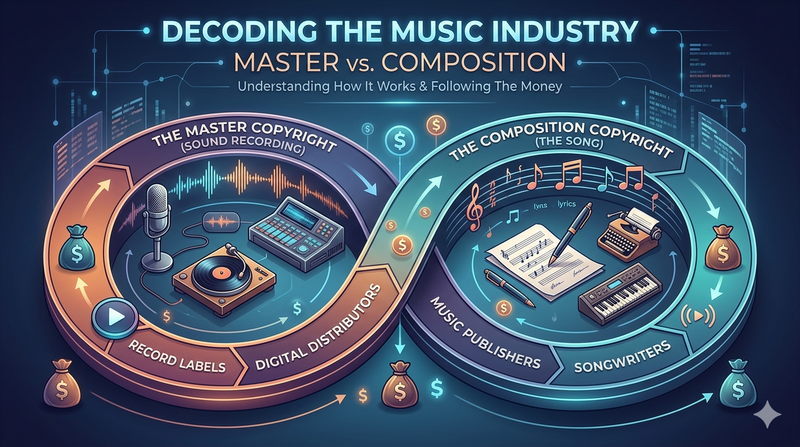
1. The Master Copyright (Sound Recording)
The master copyright covers the specific audio recording of a performance. The literal arrangement of zeros and ones on a digital file or the grooves on a vinyl record. If a band records a version of a classic song, they (or their record label) own that specific master recording.
2. The Composition Copyright (The Work)
The composition copyright covers the underlying musical work: the specific lyrics, melody, harmony, and chord progressions. This copyright belongs to the songwriters and lyricists. If ten different artists record cover versions of that same classic song, there are ten unique master copyrights, but still only one composition copyright.
As veteran music industry analyst Dan Runcie notes:
"The separation of masters and publishing is the most critical concept in the music business. Companies that understand how to leverage both sides of this coin are the ones that dictate the flow of capital in the streaming era."
The Core Players: Who Does What in the Ecosystem?
The music industry is driven by four primary pillars: artists, record labels, music publishers, and digital distributors. While the digital age has blurred the lines between these roles, each serves a distinct function in bringing music to life and capturing its value.
The Artists: The Creative Engine
Artists are the frontline creators, yet they are rarely a monolith. An individual track might involve performing artists (the faces and voices on the cover art), studio musicians, producers, songwriters, and top-liners. In the modern ecosystem, artists increasingly operate as decentralized entrepreneurs, managing their personal brands while balancing creative output.
Record Labels: The Banks and Amplifiers of the Master
Historically, record labels acted as strict gatekeepers, controlling physical manufacturing and radio airplay. Today, major labels (Universal Music Group, Sony Music Entertainment, and Warner Music Group) and prominent indies function more like venture capital firms and high-powered marketing agencies. They invest upfront capital (advances) for recording, marketing, and playlist pitching in exchange for ownership or a significant share of the master copyright royalties.
Music Publishers: The Protectors of the Song
While labels chase the master recording, music publishers hunt for the composition. Publishers sign songwriters and producers, pitch songs to performing artists, and secure placements in television, film, and video games. Their primary mandate is to track down and collect every fraction of a cent generated by the lyrics and melodies worldwide.
Distributors: The Digital Pipelines
In the physical era, distributors moved boxes of CDs and vinyl to brick-and-mortar stores. In the digital age, companies like DistroKid, TuneCore, and Believe act as the essential technical bridge between creators and Digital Service Providers (DSPs) like Spotify and Apple Music. They format audio files, deliver metadata, and ensure that streaming payouts flow accurately back to independent artists or labels.
Following the Money: The Core Revenue Streams
The transition from physical sales to access-based streaming completely re-engineered how the music industry generates wealth. Instead of lump-sum transactions, revenue is now a continuous, fragmented stream of micropayments split across several distinct categories.
1. Streaming Royalties
Streaming platforms do not pay artists a fixed rate per stream. Instead, they use a "stream share" or pro-rata model. All the subscription fees and ad revenues are pooled together, the DSP takes its cut (usually around 30%), and the remaining 70% is distributed to rightsholders based on their percentage of total platform plays.
This pool is divided into two streams: Master Streaming Royalties: Roughly 50% to 55% of the total revenue goes to the owner of the sound recording (the label or self-distributed artist).
Publishing Streaming Royalties: Roughly 12% to 15% goes to the songwriters and publishers, split into mechanical royalties and public performance royalties.
2. Performance Royalties
Whenever music is played publicly whether broadcast on the radio, blaring in a crowded nightclub, spun by a festival DJ, or streamed on a digital platform, it generates a public performance royalty for the songwriter. These fees are collected by Performance Rights Organizations (PROs) like ASCAP, BMI, and PRS, which track public usage, collect licensing fees from venues and broadcasters, and distribute them to publishers and writers.
3. Mechanical Royalties
Mechanical royalties are legally mandated fees owed to songwriters whenever a song is reproduced in a physical or digital format. Historically, this meant the physical pressing of a vinyl record or CD. Today, digital streaming is legally recognized as a simultaneous reproduction and performance, meaning every stream triggers a micro-mechanical royalty. In the United States, these are centralized and paid out via the Mechanical Licensing Collective (MLC).
4. Synchronization (Sync) Licensing
Sync licensing occurs when a song is paired with visual media, such as a television show, movie trailer, video game, or commercial advertisement. Sync is highly lucrative because it requires a dual license: one fee to the label for the use of the master recording, and an equivalent fee to the publisher for the use of the underlying composition. A single prominent Netflix sync placement can yield tens of thousands of dollars upfront, while instantly catapulting an unknown track into global viral charts.
The Streaming Paradigm and the Power Shift
The shift to streaming rescued the music industry from its post-Napster piracy collapse, driving global recorded music revenues to historic highs. However, it also fundamentally changed how music is discovered and valued.
In a world where 100,000 new tracks are uploaded to digital platforms every single day, algorithmic curation has replaced traditional radio DJs as the primary kingmaker. Spotify’s Discover Weekly, RapCaviar, and TikTok’s audio algorithms hold immense power. Success is no longer measured solely by first-week album sales, but by long-term audience retention, playlist algorithmic triggers, and user-generated content engagement.
As the International Federation of the Phonographic Industry (IFPI) noted in their Global Music Report:
"The modern recorded music market is incredibly competitive and deeply interconnected. Success requires a sophisticated blend of localized cultural insight and global digital strategy."
This hyper-saturation has led to a major strategic pivot: the institutionalization of music catalog acquisitions. Because hit songs act as stable, uncorrelated yield-generating assets similar to real estate investment firms and major music funds have spent billions acquiring the publishing and master catalogs of legacy artists, proving that great songs retain immense economic value decades after their initial release.
Conclusion: Navigating the Industry of Tomorrow
The modern music industry is a beautiful, volatile paradox. It has never been easier to record and distribute a piece of music, yet it has never been more challenging to break through the digital noise and build a profitable business. The landscape rewards the agile, the informed, and those who treat their intellectual property with the same seriousness they bring to their art.
By recognizing that music is an intersection of masters and compositions, governed by an intricate network of labels, publishers, and distributors, creators can take control of their financial destinies. The industry is no longer just about signing a contract and hoping for stardom; it is about managing an international digital business, one stream, one sync, and one copyright at a time.

Comments
No comments yet. Be the first to comment!